
About This Course
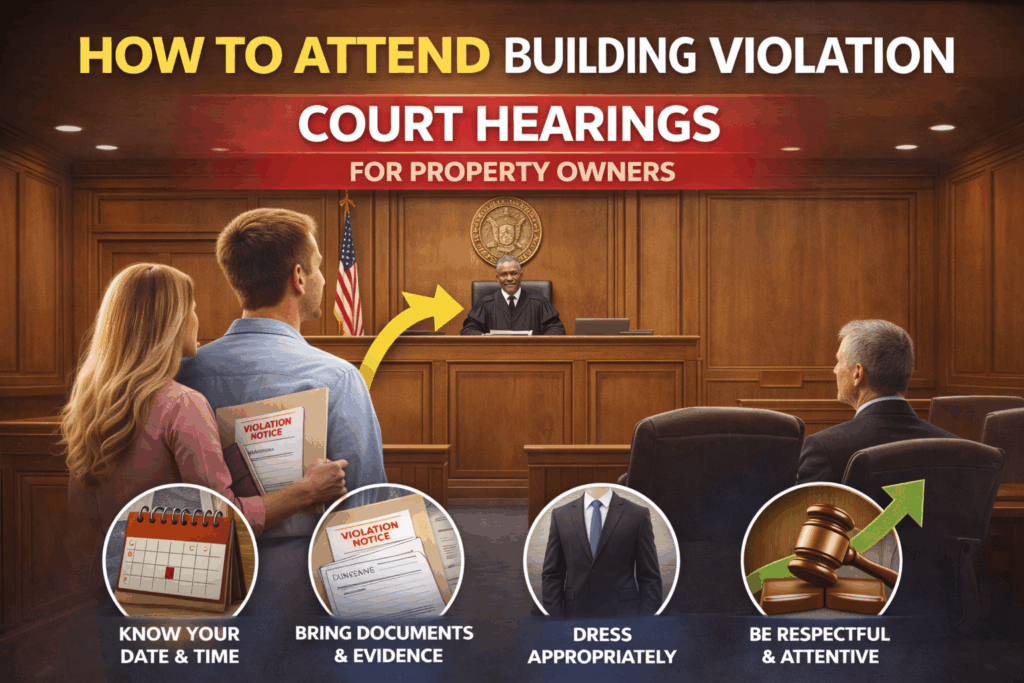
In this course you will learn how to register and attend building violation court hearings remotely by phone, or in person. Taking a course on How to Attend Building Violation Court Hearings for Property Owners—especially in the context of NYC OATH/Environmental Control Board (ECB) hearings for building code and environmental violations—can provide practical, legal, and financial advantages if you own, manage, or are responsible for NYC real estate. These hearings are administrative law proceedings where you either contest or respond to violations issued by agencies like the Department of Buildings (DOB) and must often appear before an administrative law judge.
Is knowing how to attend violation court hearings in New York City a valuable skill set?
Yes — knowing how to attend violation court hearings in New York City is a very valuable and specialized skill, especially in property management, building compliance, and real estate operations. These hearings are primarily handled by the New York City Office of Administrative Trials and Hearings (OATH), which decides violations issued by agencies like the New York City Department of Buildings, New York City Fire Department, and New York City Department of Housing Preservation and Development.
Here’s why this skill is valuable:
1. Makes You Highly Useful to Property Owners and Managers
Most building owners don’t know how to navigate violation hearings. If you can:
- Read and interpret violation notices
- Prepare documentation and evidence
- Represent ownership or assist attorneys
- Attend hearings and track outcomes
You become an asset in roles such as:
- Property manager
- Compliance coordinator
- Building superintendent
- Asset manager assistant
- Real estate operations specialist
2. Saves Property Owners Thousands of Dollars
Violations can carry penalties from $500 to $25,000+ per violation, depending on severity.
Knowing how to:
- Request hearing postponements
- Present correction proof properly
- Negotiate reduced penalties
can significantly reduce financial losses.
3. Helps Prevent Liens, Judgments, and Property Complications
Unresolved violations can lead to:
- Property liens
- Judgments
- Issues with refinancing or selling property
- Increased insurance costs
Understanding the hearing process helps keep properties compliant and financially stable.
4. Rare Skill That Gives You a Competitive Resume Advantage
Most people in entry-level property management do not understand:
- OATH hearing procedures
- Violation classification (Class 1, 2, 3)
- Default judgments vs. dismissed violations
- Certification of correction vs. penalty resolution
This makes you more valuable than other candidates.
5. Opens Doors to Higher-Paying Roles
This skill can help you move into positions like:
- Compliance specialist
- Property manager ($65k–$120k/year in NYC)
- Real estate asset coordinator
- Building compliance consultant
6. Especially Valuable in NYC Due to Strict Enforcement
New York City has some of the strictest enforcement in the U.S. Agencies frequently issue violations for:
- Elevators
- Boilers
- Fire protection systems
- Facades
- Sprinklers
- Illegal construction
Someone who understands violation hearings is extremely useful.
Resume Value Example Statement
You could list it like this:
“Trained in attending and assisting with NYC OATH violation hearings, including violation interpretation, documentation preparation, compliance tracking, and penalty resolution.”
Bottom Line
Yes — this is a high-value, specialized, career-building skill, especially if combined with knowledge of:
- NYC building systems
- NYC building codes
- Violation search tools
- Certification of correction procedures
These combined skills can make you highly competitive in NYC property management and compliance careers.
Here is the step-by-step process for attending and successfully handling a violation hearing with the New York City Office of Administrative Trials and Hearings (OATH). This applies to violations issued by the New York City Department of Buildings, New York City Fire Department, and New York City Department of Housing Preservation and Development.
Step 1: Receive and Review the Violation Notice
When a violation is issued, it includes:
- Violation number
- Property address
- Agency issuing the violation
- Description of the violation
- Hearing date
- Penalty amount
- Cure date (if eligible)
Your job:
- Read the violation carefully
- Identify what the inspector claims is wrong
- Determine if it can be corrected before the hearing
Important: Some violations can be dismissed if corrected before the hearing (“cure”).
Step 2: Check the Violation Status Online
Use NYC violation search systems such as:
- OATH Hearings Division portal
- DOB BIS (Building Information System)
- DOB NOW
- HPD Online
Check for:
- Hearing date
- Default status
- Cure eligibility
- Evidence requirements
Step 3: Correct the Violation (If Possible)
Fix the issue before the hearing. Examples:
- Repair sprinkler system
- Fix illegal electrical work
- Restore fire safety devices
- Remove illegal construction
Take proof, such as:
- Photos before and after
- Invoices
- Contractor receipts
- Permits
- Inspection reports
This proof is critical.
Step 4: Prepare Your Defense Documentation
Bring organized documents:
- Violation notice
- Photos
- Repair invoices
- Permits
- Contractor affidavits
- Inspection reports
- Certificate of correction (if filed)
Organize everything clearly.
This increases your chances of dismissal or reduced penalties.
Step 5: Attend the Hearing (Online or In Person)
Hearings are conducted:
- Online (most common now)
- Or at OATH hearing offices
Participants include:
- Administrative Law Judge
- Respondent (owner, manager, or representative)
- Agency representative (sometimes)
Step 6: Present Your Case to the Judge
The judge will ask:
- Do you admit or deny the violation?
You can respond:
Option A: Admit and show correction
- Shows responsibility
- May reduce penalties
Option B: Deny and present evidence
Example defenses:
- Violation already corrected
- Violation issued in error
- Wrong location
- No violation existed
Show your proof clearly.
Step 7: Judge Makes a Decision
Possible outcomes:
1. Dismissed
Best outcome
No penalty
2. Sustained with Reduced Penalty
Violation upheld but fine reduced
3. Sustained with Full Penalty
Violation upheld with full fine
4. Default Judgment
Worst outcome (if you don’t attend)
Maximum penalty applied
Step 8: Pay Penalty or Complete Compliance
After the hearing:
- Pay penalty (if required)
- File Certificate of Correction (if required)
- Monitor violation status until closed
Penalty and correction are separate. Paying the fine does NOT remove the violation—you must also certify correction.
Example Real-World Scenario
Violation: FDNY sprinkler valve closed
You bring:
- Photo showing valve open
- Contractor invoice
- Inspection report
Judge reviews evidence → violation may be dismissed or penalty reduced.
Step 9: Track Final Status
Continue checking violation systems until status shows:
- Complied
- Closed
- Dismissed
Skills You Gain From This Process
This skill allows you to:
- Protect property owners financially
- Resolve violations faster
- Avoid liens and legal problems
- Increase property value
- Become valuable in property management careers
Resume Example
“Experienced in NYC OATH violation hearing procedures, including evidence preparation, violation resolution, compliance documentation, and administrative hearing representation.”
how to beat common NYC violations like DOB, FDNY, and HPD violations, which is extremely valuable in property management.
Here are the most common violations from the New York City Department of Buildings (DOB), New York City Fire Department (FDNY), and New York City Department of Housing Preservation and Development (HPD) — and exactly how professionals successfully fight or resolve them at the New York City Office of Administrative Trials and Hearings (OATH).
DOB Violations (Buildings Department)
1. Illegal Construction Without Permit
Example: Installing walls, plumbing, or electrical work without a permit
How to beat or reduce it:
- Obtain proper permits immediately
- Hire a licensed contractor
- File permits with DOB
- Bring proof to the hearing:
- Permit approval
- Contractor invoice
- Photos of corrected work
Defense options:
- Work was pre-existing
- Work was minor repair, not requiring permit
- Violation issued in error
Best outcome: Penalty reduction or dismissal
2. Failure to Maintain Building (Facade, structure, stairs)
Example: Cracks, broken stairs, loose facade
How to beat it:
- Repair the condition quickly
- Hire licensed contractor
- Bring:
- Repair invoice
- Photos before and after
Judges often reduce penalties if corrected quickly.
3. Failure to File Required Inspection Reports
Examples include:
- Elevator inspection not filed
- Boiler inspection not filed
- Facade inspection not filed
How to beat it:
File the missing report immediately and bring proof.
FDNY Violations (Fire Department)
1. Sprinkler System Not Maintained
Example: Closed valve, damaged sprinkler head
How to beat it:
- Fix immediately
- Hire licensed fire protection contractor
- Bring:
- Invoice
- Photos
- Inspection report
Penalty often reduced if corrected fast.
2. Blocked Fire Exits
Example: Storage blocking exit path
How to beat it:
- Remove obstruction immediately
- Take photos showing exit clear
This violation is often dismissed if corrected.
3. Failure to Maintain Fire Extinguishers
Example: Missing or expired extinguishers
How to beat it:
- Replace extinguishers
- Bring purchase receipt and photos
HPD Violations (Housing Department)
1. No Heat or Hot Water
Very serious violation.
How to defend:
- Show proof heat/hot water restored quickly
- Bring repair invoices
- Bring boiler repair documentation
Penalty often reduced.
2. Unsafe Apartment Conditions
Examples:
- Mold
- Leaks
- Broken windows
How to beat it:
- Repair immediately
- Bring photos and repair receipts
3. Failure to Register Property with HPD
How to fix:
- Register property immediately online
- Bring proof of registration
Often results in reduced penalties.
Most Powerful Evidence to Bring to OATH Hearings
Always bring:
- Photos (before and after)
- Contractor invoices
- Permits
- Inspection reports
- Contractor affidavits
- Proof of correction
This dramatically improves your outcome.
Professional Strategy Used by Property Managers
Experienced professionals do this:
- Correct violation immediately
- Gather documentation
- Organize evidence clearly
- Attend hearing prepared
- Show compliance effort
Judges are more lenient when they see correction.
Violations That Are Hardest to Beat
These require strong defense:
- Illegal occupancy
- Illegal conversion
- Serious safety hazards
- Repeat violations
These often require permits and professional help.
Violations Easiest to Beat or Reduce
These are easier:
- Paperwork violations
- Missing inspection reports
- Maintenance issues corrected quickly
- Administrative violations
Why This Skill Is Extremely Valuable
Property owners constantly face violations. Someone who can:
- Understand violations
- Fix problems properly
- Attend hearings
- Reduce penalties
can save owners thousands of dollars and become highly valuable in property management.
Course Curriculum
- Self-Paced Learning
- Full Lifetime Access
- Access on Mobile
- Certificate of Completion